
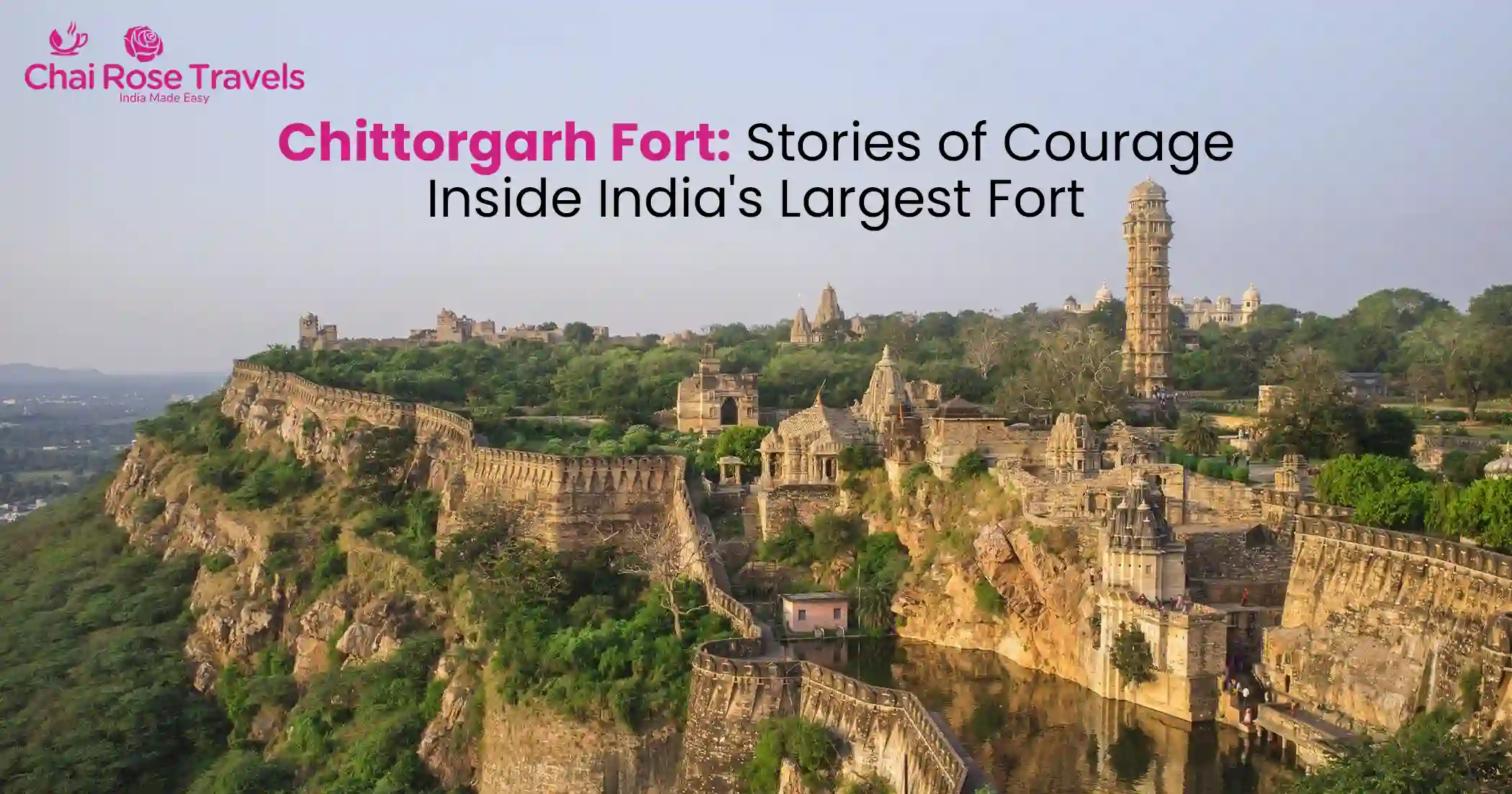
Chittorgarh Fort is a UNESCO World Heritage hill fort in southern Rajasthan, and one of the biggest forts in India. It is famous for three great sieges, a handful of unforgettable names and the stories of courage that still define Mewar. If you are weighing up chittorgarh fort tour packages, this guide tells you what really happened here, which tales are legend, and how to spend your time on the hill.
Too many itineraries treat Chittorgarh as a quick stop between Udaipur and Jaipur. Give it half a day instead. The fort is a walled hilltop town of palaces, towers, temples and reservoirs, and it makes far more sense with someone beside you who can match each story to its place. That is what good Chittorgarh travel packages should do: put the right guide at the right gate.
One thing before we start. Chittorgarh’s stories come in three kinds, and we mark them so you always know what you are hearing:
- Documented: backed by records or archaeology.
- Disputed: historians argue about it.
- Folk tradition: loved, retold and passed down, but never proven.
Chittorgarh Fort at a Glance
| Detail | What to know |
| Location | Chittorgarh, southern Rajasthan |
| Height | About 180 metres above the plains |
| Size | About 700 acres, with a 13 km perimeter wall |
| UNESCO status | One of six Hill Forts of Rajasthan, inscribed in June 2013 |
| UNESCO area | 305 hectares, with a 440 hectare buffer zone |
| Structures | 65 historic structures: 4 palaces, 19 large temples, 20 large water bodies, memorials and a victory tower |
| Protection | Monument of National Importance, listed in 1956 |
| Gates | Seven, climbing from the base to the main gate |
The other five forts in the UNESCO group are Amer, Gagron, Jaisalmer, Kumbhalgarh and Ranthambore.
Is Chittorgarh Fort India’s Largest Fort?
India’s own tourism board calls it the country’s largest fort complex, about 6 km long and 1.5 km wide. By area, it is the fort most people name first.
You will see two sizes quoted. About 700 acres (roughly 280 hectares) describes the whole hilltop. UNESCO’s 305 hectares describes the area it inscribed. Same fort, different boundary lines. So when you hear “the largest fort in India”, read it as “the one that sets the standard for size”. Walk it for an afternoon, and you will see why.
History of Chittorgarh Fort: Origins and the Rise of Mewar
The earliest finds on the hill date to the 5th century. UNESCO’s evaluation says a Maurya (Mori) ruler named Chitrangada built the first stronghold in the 7th century, and India’s tourism site tells the same story. A local legend goes further and credits Bhima of the Mahabharata with the Bhimlat Kund pool, said to mark where he struck the ground. That one is folklore.
Another tale says Bappa Rawal took the fort in the 8th century. That too is tradition, and some historians doubt it.
The firmer ground starts in 1336, when UNESCO’s evaluation says the Sisodias of Mewar took the Chittorgarh Fort. They kept it as their capital. Two rulers shaped the fort you climb today:
- Rana Kumbha (1433 to 1468): He planned the great defences with his architect, Mandan. The seven gates, the main walls and the Vijay Stambh come from his reign.
- Rana Sanga (from 1509): Under him, Mewar reached its peak. He lost to Babur at Khanwa and died in 1528.
Three Sieges at a Glance
| Year | Attacker | What happened | Status |
| 1303 | Alauddin Khalji of Delhi | Fort fell after about eight months | Siege documented. Padmini story disputed |
| 1535 | Bahadur Shah of Gujarat | Fort sacked | Siege documented. Jauhar details from later accounts |
| 1567 to 1568 | Akbar | Fort fell in February 1568 after about four months | Siege documented |
Accounts of how many died vary widely, so we do not quote a single number.
Stories of Courage: What History Says, What Legend Adds
Rani Padmini and the Siege of 1303 (Image)
Verdict: The siege is fact. The Padmini story is legend.
Alauddin Khalji did take Chittorgarh in 1303, after about eight months. The famous tale says he came for Rani Padmini, that he glimpsed her reflection in a mirror, and that she and the women of the fort chose jauhar rather than surrender.
History Hit notes that there seems to be no evidence for that jauhar. Historians cited by Wikipedia go further. Most reject the Padmini tale. One accepts that a jauhar took place but calls Padmini unhistorical. Another thinks even the jauhar was added later, because Alauddin’s court writer, Amir Khusrow, does not mention it.
Where to stand: Padmini Palace, the white three-story building overlooking the reservoir. UNESCO’s evaluation says it was reconstructed in the early 19th century, so it is not the palace of her day. Still, it inspired the lake palaces you see all over Rajasthan.
Rani Karnavati and the Siege of 1535 (Image)
Verdict: The siege is documented. The jauhar figures come from later accounts.
In 1535, Sultan Bahadur Shah of Gujarat attacked. Tradition says Rani Karnavati led the women of the fort in jauhar, while the warriors rode out for a last battle. Guidebooks repeat the numbers 13,000 women and 3,200 men. Those figures come from later accounts, so treat them as tradition.
The same accounts tell us the young prince Udai Singh was smuggled out to Bundi with his nurse, Panna Dhai.
Where to stand: The Mahasati area near the Vijay Stambh, full of sati stones. It is traditionally pointed out as the place of the 1535 jauhar.
Jaimal and Patta: The Defence of 1568 (Image)
Verdict: Documented.
Akbar arrived in October 1567. Rana Udai Singh II, on his council’s advice, left for the Gogunda hills. Two commanders, Jaimal and Patta, stayed to hold the fort with about 8,000 Rajput soldiers.
They held out for four months. Jaimal fell on 22 February 1568, according. A popular story says Akbar fired the shot himself, though nobody has confirmed that. A jauhar followed, the gates opened the next morning, and the defenders rode out to fight.
Where to stand: The Jaimal and Patta havelis. UNESCO’s evaluation lists them among the last buildings raised in the 16th century, before the Sisodias lost the fort.
Panna Dhai: Sacrifice and Loyalty (Image)
Verdict: Folk tradition in its details.
This is the story that makes Mewar families go quiet. The young prince Udai Singh was in danger. His nurse, Panna Dhai, is said to have put her own son in the prince’s bed and carried the prince out in a basket.
The details are tradition. The ending is not: Udai Singh lived, and he founded Udaipur. Panna Dhai stands for loyalty above everything.
Where to stand: Kumbha Mahal, Rana Kumbha’s palace. It dates to the 15th century and was enlarged several times.
Rana Kumbha and Rana Sanga: The Power of Mewar (Image)
Verdict: Documented.
Not every Chittorgarh story is about a last stand. Rana Kumbha raised the Vijay Stambh to mark his victory over the Sultan of Malwa. It dates to the 15th century, and UNESCO’s history table gives 1440 to 1448. It stands 37 metres high, with 157 narrow steps inside.
Rana Sanga took Mewar further than any ruler before him, then met Babur at Khanwa. Between them, these two kings show you the fort at full strength, before the sieges.
Meera Bai: Faith and Devotion (Image)
Verdict: A historical figure, with legends around her.
Meera Bai (1498 to 1546) was a poet and a devotee of Krishna. People still sing her songs across India. UNESCO’s evaluation mentions a palace of hers within the Kumbha Mahal complex. One legend says she drank poison sent by a relative and lived. That is a story, not a record.
Her temple stands near the Vijay Stambh. After the war stories, it feels like another kind of courage: sticking to your own faith.
After 1568: The Shift to Udaipur
Once Akbar took the fort, Mewar’s rulers never moved back in. Artillery had changed warfare, and a hilltop fort was no longer safe. The capital moved to Udaipur, which Udai Singh founded in the Aravalli hills.
In the early 17th century, a treaty with the Mughal emperor Jahangir returned Chittorgarh to Mewar. There was a catch: UNESCO’s evaluation says it barred the Sisodias from repairs or new building. Restoration only began after Mewar signed a treaty with the East India Company in 1818. Since 1947, the fort has been public property and a protected monument.
Chittorgarh Fort Tour: Monuments, Stories and a 2 to 4 Hour Route
You cross a limestone bridge over the Gambhiri River, then climb a winding road of just over a kilometre. Inside, a circular road links the gates and main sights. You can drive it, but you will want to get out at each stop.
The seven gates, from bottom to top
UNESCO’s evaluation lists them in this order:
- Paidal Pol (also written Padan Pol)
- Bhairon Pol
- Hanuman Pol
- Ganesh Pol
- Jorla Pol (two gates joined together, which is rare)
- Laxman Pol
- Ram Pol, the main gate
Suraj Pol is a separate gate on the east side. Spellings change from sign to sign, so do not worry if one looks different.
A sensible order for your visit
| Stop | What to look for | Story |
| Ram Pol | Carved gate with deities and old inscriptions | The defence of the fort |
| Vijay Stambh | Nine storeys of carved stone | Rana Kumbha |
| Meera Temple area | A calm corner near the tower | Meera Bai |
| Mahasati area | Sati stones near the tower | The sieges |
| Kirti Stambha | Older Jain tower, about 24 metres tall, dedicated to Adinath | Mewar’s Jain heritage |
| Kumbha Mahal | Ruined palace with balconies | Panna Dhai and Udai Singh |
| Padmini Palace | Lake palace, early 19th-century rebuild | The Padmini legend |
| Gaumukh reservoir | Spring-fed pool that kept the fort supplied | Life under siege |
| Fateh Prakash Palace | Museum in a palace built between 1885 and 1930 | Optional |
Your guide may change the order depending on traffic and heat.
Water is part of the story too. UNESCO’s evaluation counts 85 historic water structures, of which 20 still work. Three of the tanks date back to the 7th century. That is how a fort held out for months.
How long does it take to see Chittorgarh Fort? UNESCO’s periodic report records an average visit of one to three hours. For the main sights with a guide, plan two to four. If you want to see every corner, give it a full day the plateau is about 4 miles long.
Tips from the ground:
- Go in the morning. Visitors report long queues at the ticket counter in the afternoon.
- Hire a guide at the entrance, or arrange one in advance. A vehicle helps too, as the sights are spread out.
- Take your shoes off before the Vijay Stambh. The stairs are tight, and access to the inside can change, so ask at the entrance.
- The Fateh Prakash Museum is closed on Mondays.
- Hold on to your ticket. Staff check it at several points.
A Living Fort Today
Chittorgarh is not an empty ruin. When UNESCO’s advisers assessed it, about 3,000 people lived in a ward inside the walls, near Ratan Singh Tank. A later periodic report puts it at around 3,500 people in 600 to 700 houses.
So be a good guest. Ask before photographing anyone. Keep your voice down near homes and temples. As you explore the Chittorgarh tourist places will also pass stalls selling Rajasthani clothes. Many are photo studios, where you can dress up for a picture. Good fun, and easy to skip.
Chittorgarh Fort Visitor Guide
We last checked these details in October 2026.
- Visiting hours: The visiting hours of Chittorgarh Fort are roughly from 9.45 a.m. to 6.30 p.m
- Tickets: ₹40 for Indian visitors and ₹600 for foreign visitors, which is a few pounds (MakeMyTrip). The Fateh Prakash Museum has its own small ticket, around ₹50 for foreign adults and ₹10 for Indian adults. Parking costs about ₹50 per vehicle, as visitors report. On our private tours, entrance fees are arranged for you.
- Light and sound show: Daily from 7 pm to 8 pm, in English and Hindi. The Rajasthan Tourism Development Corporation, which runs the show, lists ₹150 for adults, ₹75 for children and ₹300 for foreign nationals, plus 18% GST. It tells the story from the building of the fort to Alauddin Khalji’s attack, the sacrifice of Gora and Badal, and Padmini’s jauhar. Shows are sometimes cancelled or paused, so confirm with your guide or hotel that day. Afterwards, the Fort Road Market nearby sells textiles, handicrafts and jewellery.
- Best time to visit: November to February is the sweet spot. The climate chart shows January running from about 3 °C at night to 30 °C by day, while May runs from about 21 °C to 44 °C. October and March work too, but get hot by midday.
- What to bring: Comfortable shoes, a hat, sun cream and water. The ground is uneven.
How to Reach Chittorgarh Fort
- By air: The nearest airport is Maharana Pratap Airport (UDR) at Dabok, Udaipur, about 90 km away. From the UK, you would usually fly into Delhi, then continue by air, rail or road.
- By rail: Chittorgarh Junction (COR) is the nearest station, about 6 km from the fort. Trains link Chittorgarh with Udaipur, Jaipur, Ajmer, Ratlam, Delhi, Kota and other major cities.
- By road: Regular buses run from all the major cities in Rajasthan. The fort is about 120 km from Udaipur city, on the highway network of the NH48 and NH27.
Where to Stay near Chittorgarh Fort
Most travellers base themselves in Udaipur and visit Chittorgarh as a day trip. Staying in Chittorgarh itself makes sense if you want a sunrise start or the evening show.
Whichever you choose, ask:
- How far is it from the fort gate?
- Is a car and driver included for the day?
- Can the hotel pack an early breakfast if you leave at sunrise?
- Can you get back easily after the light and sound show?
At Chai Rose Travels, we plan private, escorted tours around what you want. If you are looking at chittorgarh tour packages as part of a wider Rajasthan trip, tell us your dates and interests and we will build the route around them.
Nearby Places to Combine with Chittorgarh
- Udaipur: About 120 km by road, roughly two hours.
- Nagari: A village about 15 km west of Chittorgarh with finds going back to 443 BCE, according to Incredible India.
- Baroli Temples: A walled group of eight temples in the Gurjara Pratihara style, dating to the 9th century, also listed by Incredible India.
- Kumbhalgarh: Another UNESCO hill fort, designed by the same architect, Mandan.
- Ranthambore: The third fort here from the same UNESCO group, and a well-known wildlife area.
Our India Heritage Tour covers Udaipur, Jaisalmer and Jodhpur, and Chittorgarh can be added to a tailor-made route like it.
Chittorgarh Fort FAQs
Q1. Where is Chittorgarh Fort?
Ans: It is in the city of Chittorgarh, in southern Rajasthan, about 120 km from Udaipur by road.
Q2. Why is Chittorgarh Fort famous?
Ans: For its size, its UNESCO status and the three sieges of 1303, 1535 and 1567 to 1568, along with the stories of courage that grew around them.
Q3. Is Chittorgarh Fort the largest fort in India?
Ans: India’s tourism board calls it the country’s largest fort complex, about 700 acres in area. Depending on where you draw the boundary, it is certainly one of the largest.
Q4. How many times was the fort besieged?
Ans: Three major sieges are usually named: 1303, 1535 and 1567 to 1568.
Q5. Is the Rani Padmini story true?
Ans: The 1303 siege is real. Most modern historians reject the Padmini story itself, which comes from later poetry and tradition.
Q6. Is Chittorgarh Fort a UNESCO World Heritage Site?
Ans: Yes. It was inscribed in June 2013, as one of six Hill Forts of Rajasthan.
Q7. How much time do I need to cover Chittorgarh Fort?
Ans: Allow two to four hours for the main sights, and a full day if you want to see everything on the plateau.
Q7. What are the ticket prices and opening times?
Ans: ₹40 for Indian visitors and ₹600 for foreign visitors. The fort is listed as open from sunrise to sunset, and most guides suggest arriving by 9 am.
Q8. What is the best time to visit Chittorgarh Fort?
Ans: November to February is the ideal time, when daytime highs stay around 30 to 34 °C.
Q9. Is there a light and sound show?
Ans: Yes, daily from 7 pm to 8 pm in English and Hindi, according to Incredible India. Tickets are ₹150 for adults and ₹300 for foreign nationals, plus GST.