
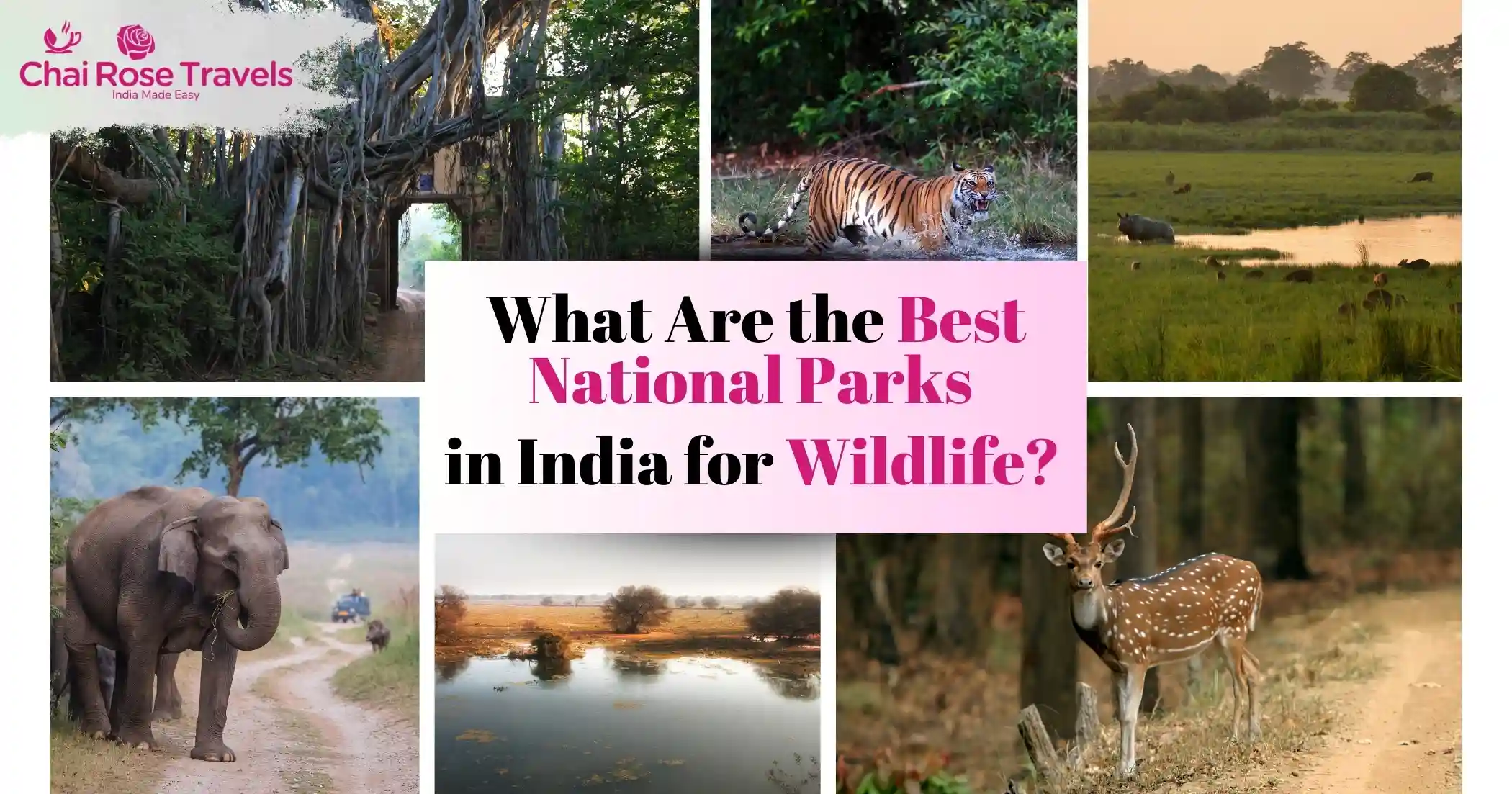
India’s best national parks for wildlife include Ranthambore in Rajasthan, Jim Corbett in Uttarakhand, Bandhavgarh and Kanha in Madhya Pradesh, and Kaziranga in Assam, each offering a fundamentally different wildlife experience, from Bengal tiger safaris against a backdrop of medieval ruins to encounters with the greater one-horned rhinoceros in a UNESCO World Heritage floodplain. Choosing between them depends less on which is “best” in the abstract and rather more on what you are hoping to see, how long you have, and when you are travelling from the UK.
India’s Wildlife: Why This Moment Matters
India’s tiger population was estimated at 1,411 in 2006. By 2022, the country’s tiger population was estimated at 3,682, with an estimated range of 3,167–3,925, according to the National Tiger Conservation Authority’s All India Tiger Estimation. This represents an increase of about 161% from the 2006 estimate. The recovery has been supported by conservation measures under Project Tiger, improved protection and monitoring, habitat management, and efforts involving local communities around tiger reserves. In Ranthambore and other tiger landscapes, anti-poaching patrols, habitat protection and reserve management remain important parts of tiger conservation.
For UK travellers who think carefully about where their money goes, wildlife tourism in India is among the clearest examples of ethical travel producing measurable conservation outcomes. Your safari permit fees and accommodation spend are part of the economic argument for a living tiger being worth more than a dead one.
Which Indian National Park Is Best for Your Wildlife Goal?
Before choosing a park, it helps to be honest about what you are most likely to see — and what a park’s particular strengths are.
| Park | Wildlife Strength | Best Window |
|---|---|---|
| Ranthambore | Bengal tiger, Ranthambore Fort, Padam Talao lake area | October–May |
| Jim Corbett | Tiger, elephant, 600+ bird species, gharial | November–June (zone-dependent) |
| Bandhavgarh | Bengal tiger, dense forest encounters | October–March |
| Kaziranga | Greater one-horned rhinoceros, elephant | November–April |
| Kanha | Tiger, leopard, hard-ground barasingha | November–March |
| Keoladeo (Bharatpur) | Migratory birds, water birds | November–February |
Choose this if you want a tiger safari without extending your trip significantly: Ranthambore.
You are birding or travelling with children and want diversity: Corbett.
You want an experience most tourists never reach: Kaziranga.
You want the full central India wildlife immersion: Bandhavgarh or Kanha.
List of Best National Parks in India
India’s best national parks offer diverse wildlife experiences, from tiger safaris and elephant habitats to rhino-rich grasslands and Himalayan landscapes. Let us see the best of them one by one.
1. Ranthambore National Park: The First-Timer’s Tiger Reserve
Located in Sawai Madhopur district, Rajasthan — approximately 195 kilometres from Jaipur and 400 kilometres from Delhi — Ranthambore is the most naturally integrated tiger reserve in India. What distinguishes it from every other park is not just the tigers but the landscape they share with human history. The 10th-century Ranthambore Fort sits within the active tiger reserve. The three main lakes — Padam Talab, Raj Bagh Talab, and Malik Talab — create concentrated wildlife corridors around water. Seeing a Bengal tiger walk the edge of a 1,000-year-old fort wall at first light is an experience specific to Ranthambore and nowhere else.
The reserve has ten safari zones. Zones one to five, which encompass the lakes and the fort, consistently produce the most reliable sightings. Permits for these zones open 90 days in advance on the Rajasthan government portal and fill quickly — particularly for the morning safari slots in October through February. Book early. Do not leave this until you arrive in India.
Best time: October through May. The park closes from late June to late September for the monsoon.
2. Jim Corbett National Park: India’s Oldest, Still Its Most Diverse
Jim Corbett National Park in Uttarakhand — established in 1936 as Hailey National Park, and the first reserve under Project Tiger in 1973 — offers what none of the Central Indian tiger parks do: genuine ecological variety. Rivers, chaurs (open grasslands), and dense sal forest support over 600 bird species alongside tigers, elephants, leopards, and gharial crocodiles.
The Dhikala zone is where the best encounters happen — and the reason overnight access matters is not just about timing. Staying in the Dhikala forest rest house puts you inside the park boundary before dawn. When the morning safari begins, you are already there — no gate wait, no drive-in delay. You are in the grassland at first light while other vehicles are still twenty minutes away. For families, or travellers who want wildlife without a singular tiger focus, this quality of sustained, unhurried contact with a landscape is what Corbett does that most Indian parks cannot.
Best time: November to June. Dhikala closes during the monsoon; other zones remain partially open.
3. Bandhavgarh National Park: A Dedicated Central Indian Safari
Bandhavgarh in Madhya Pradesh is consistently one of the most productive tiger reserves in India for sightings. Established in 1968 and brought under Project Tiger in 1993, it covers 1,150 square kilometres of mixed forest, meadow, and hillside terrain. At Ranthambore, a tiger often walks toward you across open ground — the encounter builds over minutes. At Bandhavgarh, it appears from the treeline at fifteen metres with no build-up. Both are extraordinary. They are not the same experience, and which stays with you longer depends entirely on the person.
In April and May, as water sources dry, tigers concentrate around the diminishing pools. Sighting rates in these months frequently exceed those of peak winter season. This is not obvious advice, and most UK visitors do not consider it.
Bandhavgarh is not sensibly combined with the Golden Triangle. It requires a dedicated central India trip — typically flying into Jabalpur or Bhopal.
Best time: October through March; or April–May for late-season concentration sightings.
4. Kaziranga National Park: Where the Rhinoceros Comes First
Kaziranga in Assam is a UNESCO World Heritage Site (designated in 1985) and holds approximately 70 per cent of the world’s global population of the greater one-horned rhinoceros — 2,613 individuals counted in the 2022 census. (Source: India Ministry of Environment, Forest and Climate Change, September 2024.)
The park’s floodplain ecology is unlike anything else in India. Each monsoon, the Brahmaputra floods large sections of Kaziranga, forcing wildlife onto higher ground. When the waters recede between November and April, the concentration of animals across the newly accessible grasslands can be extraordinary. Rhinos in the hundreds, wild buffalo, swamp deer, and tigers — Kaziranga has one of the highest tiger densities of any Indian reserve — move through the landscape as it reawakens.
In the Kohora range at dawn, an elephant-back safari takes you through grass taller than the elephant at shoulder height. A one-horned rhino encountered at four metres in these conditions does not flee — because the elephant’s scent does not trigger the same alarm response that a jeep engine would. You are close enough to hear its breathing. Kaziranga requires a separate northeast India journey — it cannot be added to a Golden Triangle itinerary. But for those who make the trip, it is without qualification a different India.
Best time: November to April, with March to early April offering the best post-flood concentration sightings.
5. Kanha National Park: The Jungle Book Country
Kanha in Madhya Pradesh is where Rudyard Kipling drew from for The Jungle Book — and the landscape confirms why. Spanning 1,945 square kilometres, it is one of India’s largest tiger reserves, with sal and bamboo forest, rolling grasslands, and the Banjar River running through it.
Kanha is the only place in the world where the hard-ground barasingha (Cervus duvaucelii branderi) lives. In the 1970s, fewer than 70 remained. Today, over 700 move across Kanha’s meadows in herds. Watching a barasingha crossing at dusk — knowing that recovery — is a different experience from watching an animal you know nothing about. Kanha rewards the traveller who arrives with some knowledge and leaves with more.
Best time: November through March.
When Should UK Travellers Visit India’s National Parks?
Most of India’s tiger reserves follow the same broad pattern: open October through May or June, closed during the monsoon. Here is how that maps to UK school holidays:
February Half-Term — One of the best windows. Tiger reserves across Rajasthan, Uttarakhand, and Madhya Pradesh are in full operation. Keoladeo (Bharatpur), near Agra, is at its peak for wintering migratory birds.
Easter (April) — Water sources begin drying. Tiger concentration around remaining pools increases sighting probability at Ranthambore and Bandhavgarh. Slightly warmer but manageable at dawn.
October Half-Term — The post-monsoon reopening. Fresh forest, lower visitor volumes than December. Underrated and genuinely good.
Christmas and New Year — Peak demand. Excellent weather (15–22°C, clear skies). Book safari permits 90 days in advance without exception.
Summer Holidays (July–August) — Most tiger reserves are closed. Hemis National Park in Ladakh is the specialist alternative — snow leopard habitat, fully accessible in summer. Corbett’s buffer zones remain partially open.
UK school holiday dates vary between England, Scotland, and Wales — confirm specific dates before planning around any particular window.
Golden Triangle + Ranthambore: A Wildlife Extension That Works
The Golden Triangle — Delhi, Agra, Jaipur — is the most travelled circuit in India for a reason. It covers three of the country’s most significant heritage sites within a sensible driving range. Ranthambore adds a fourth dimension to this journey without requiring a separate logistics chain.
The routing works naturally: Delhi → Agra (3 hours) → Jaipur (4 hours from Agra) → Ranthambore (3 hours from Jaipur) → Delhi (4.5 hours). Or the reverse, beginning with Ranthambore straight from Delhi before the heritage circuit. Either direction, Ranthambore sits at a geographic point that makes it an extension rather than a detour.
A stay of two to three nights is recommended — enough for two morning safaris and one evening safari, which meaningfully increases sighting probability without extending the trip uncomfortably. A 10 to 12-day itinerary accommodating the full Golden Triangle and two to three nights at Ranthambore is realistic and leaves each destination with enough time to breathe.
Ready to Add a Wildlife Experience to Your India Trip?
Combine India’s iconic Golden Triangle with a memorable Ranthambore safari.
Chai Rose Travels can help you plan a private India itinerary around your interests,
travel dates and preferred pace.
Plan Your Wildlife Tour of India with Chai Rose Travels
Chai Rose Travels is a UK-based India specialist building private, escorted itineraries that combine heritage travel with wildlife experiences across Rajasthan and beyond. Whether you are planning a Golden Triangle tour with Ranthambore, a dedicated wildlife tour in India, or a first trip that needs to cover both, their team — including Vikash Dubey, whose roots in Ranthambore run deeper than any guidebook — designs trips around what actually matters to you.
Tours from £1,400 per person. IATO affiliated. TripAdvisor Travellers’ Choice.
FAQs
Which is the best national park in India for seeing tigers?
Ranthambore in Rajasthan is the most practical choice for most UK visitors, accessible from Jaipur, combinable with the Golden Triangle, and consistently productive for tiger sightings across a long season (October to May). Bandhavgarh in Madhya Pradesh offers arguably more intense tiger encounters, but requires a separate central India journey. The honest answer is that tiger sightings are never guaranteed anywhere. Both parks have days where nothing appears and days where sightings last an hour.
How far in advance do I need to book a Ranthambore safari?
Permits for the core zones (Zones 1–5) open 90 days in advance on the Rajasthan government wildlife booking portal. Morning slots in these zones during October through February fill within hours of opening — sometimes within minutes for Zone 1. If you are travelling during peak season, your operator needs to be ready at the booking window the moment it opens. This is not an exaggeration. Working with a specialist who monitors and manages this on your behalf is the practical solution.
Is it worth adding a national park to a Golden Triangle tour?
Yes. If the addition is Ranthambore and you allow two to three nights. Ranthambore sits naturally on the return leg between Jaipur and Delhi, requiring no significant detour. Two morning safaris provide a genuine chance of a sighting. One night at a forest-edge property with a naturalist briefing transforms the experience from a box-ticking addition into a meaningful encounter with a landscape that is quite unlike anything else on the standard India circuit.